© photo by Daniel DeMarle 2018
© photo by Daniel DeMarle 2018
© photo by Daniel DeMarle 2018
Something had changed my people politically in the 20 years since my then teenage mom had voted for Jimmy Carter when I was an infant, the year Reagan won. There I was to prove it – a liberally minded young person from the rural working class who had somehow voted Republican.
Whatever caused the change, it crystallized with the popularity of a new conservative cable TV network. We didn’t have cable at the farm, but in Wichita Mom had started listening to conservative talk radio. She’d nod along in the car as a host spewed venomous attacks on liberalism. Something in his apparent outrage about “government handouts” appealed to her. She was open-minded and progressive on most social issues but raised a defiant middle finger to the idea of so-called assistance, so I did, too. I voted for Kansas native Bob Dole in my rural high school’s 1996 mock presidential election. Mom and I cheered when the GOP retained a majority in both houses that year.
One of my aunts was the only person in our family who I recall refusing to budge from older affiliations between class and party. “The Democrats are for poor people, and the Republicans are for the rich,” she would declare and slam her beer on the table.
“No,” Mom would reply. “Democrats help people, and Republicans help people help themselves.”
People on welfare were presumed “lazy”, and for us there was no more hurtful word. Within that framework, financially comfortable liberals may rest assured that their fortunes result from personal merit while generously insisting they be taxed to help the “needy”. Impoverished people, then, must do one of two things: concede personal failure and vote for the party more inclined to assist them, or vote for the other party, whose rhetoric conveys hope that the labor of their lives is what will compensate them. It’s a hell of a choice, and initially I made mine based on my mother’s ideas at the time. My liberal peers were no different in that respect, for the most part having shown up on campus with their parents’ beliefs.
A sociology course the spring of my junior year dismantled my political views about fiscal policy. Study after study that I found in my research for the class plainly said in hard numbers that, if you are poor, you are likely to stay poor, no matter how hard you work. As I examined the graphs over and over, my heart sped up with shock and anger. On the matter of my own country’s economic system, for all my family wisdom about what something ought to cost and who was peddling a con, I had been sold a bill of goods.
The people I’d grown up with were missing that information. But the liberal people I met in college often were missing another sort of information: what it feels like to pee in a cup to qualify for public benefits to feed your children. A teenager’s frustration when a dilapidated textbook is missing a page and there’s no computer in the house for finding the lesson online. The impossibility of paying a citation for expired auto insurance, itself impossible to pay despite 50 hours a week holding metal frying baskets at KFC.
It wasn’t that I’d been wrong to be suspicious of government programs, I realized, but that I’d been wrong to believe in the American Dream. They were two sides of the same trick coin – one promising a good life in exchange for your labor and the other keeping you just alive enough to go on laboring.
My mother and other family members would soon make similar shifts just by following the news and seeing cracks in the political messages they had received. Without need for a college class, many abandoned their short-lived conservatism for progressive views.
As college experiences took me outside my home state, I realized that Kansas as a whole suffered from a disconnect with power that was similar to what I experienced on the farm. The broader country viewed states like mine as unimportant, liminal places. They yawned while driving through them, slept as they flew over them.
Published in the Guardian “Country pride: what I learned growing up in rural America.”
Copyright © 2018 by Sarah Smarsh. An edited and abridged excerpt from the forthcoming book Heartland: A Memoir of Working Hard and Being Broke in the Richest Country on Earth by Sarah Smarsh, to be published by Scribner, an imprint of Simon & Schuster, Inc. Printed by permission
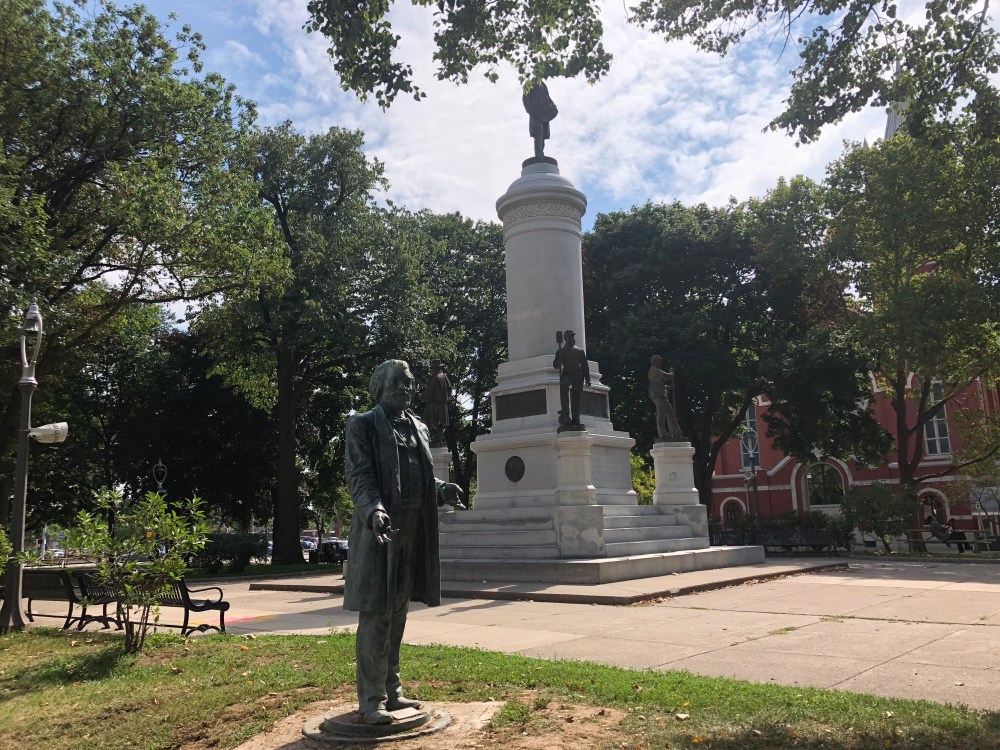
Frederick Douglas Statue by Olivia Kim
© photo by Daniel DeMarle 2018
WILLIAM AUGUSTINE CURRAN
32 Epworth Street, Rochester, N. Y.
 William Augustine Curran was born in Mumford, N. Y., October 2, 1896, son of James F. and Catherine Curran. He was graduated from Immaculate Conception School and a former pupil of the Rochester Catholic High School and West High School. At time of enlistment he was employed as clerk in the offices of the Buffalo, Rochester & Pittsburgh Railway Co., at Rochester, N. Y. He entered the service at Rochester, N. Y., April 6, 1917, the day the United States declared war, at the age of 20 years, as a Private, in the National Guard of New York, in Company G, 3rd Infantry, later Company G, 108th Infantry. He was trained at Pelham Bay, N. Y., and Camp Wadsworth, Spartanburg, S. C. Promoted to Private, 1st Class, May 1, 1918. He embarked overseas from New port News, Va., on the transport General Grant, arriving at Brest, France, May 30, 1918. He was engaged in action in East Poperinghe Line from July 9, 1918, to August 20, 1918; Dickebusch Sector, August 21, 1918; Vierstraat Ridge, Belgium, August 31, 1918; The Knoll, Guillemont Farm, September 27, 1918, and on the Hindenburg Line, between Cambrai and St. Quentin, September 29, 1918. The battle at Cambrai was his sixth. The night before he was killed he wrote his mother a letter saying his Regiment was again going into action the next day and they were confident of breaking the Hindenburg Line. He received a citation certificate from General Pershing for gallantry in action. He was killed in action, September 29, 1918, in front of Bony, France, between Bony and St. Quentin. Although he lived but sixteen minutes after he was hit, he was conscious until his death. A ring which he wore he took from his finger and asked his comrade, Private H. Eisenhart, to mail to his mother, and said: “Tell them back home I died game and am ready to go.” He was buried in St. Emelies Cemetery near Le Catelet. Later his body was brought back to America on the U.S.A.T. Somme, March 14, 1921, with four other members of the 108th Infantry.
They were the first Gold Star boys to be brought back to Rochester, and a public Memorial service was held at the Armory for them, March 22, 1921. The bodies were conveyed in procession through the heart of the city to the Armory, the streets being lined with people who paid silent tribute to those who had died for us. The military escort was furnished by Troop H and the 108th Regiment. Members of the Common Council, of the Board of Supervisors, and men prominent in civic and business life marched behind Major Frederick S. Couchman, the soldiers and the Park Band. Pupils of the public and parochial schools stood along the curbing holding American flags. All along the line of march, from the New York Central Station to the Armory, public buildings and dwellings displayed flags at half mast, in accordance with the suggestion of Mayor Hiram H. Edgerton. A very impressive service was held at the Armory, where thousands gathered to pay their respects. The opening and closing prayers were offered by Rev. Clinton Wunder, Pastor of the Baptist Temple, and Rev. George F. Kettell, of St.
Bernard’s Seminary. Hon. Charles E. Ogden, as personal representative of Mayor Edgerton, delivered a beautiful tribute to the dead heroes. Colonel Frederick W. Galbraith, Jr., of Cincinnati, National Commander of the American Legion, also gave an address. A detachment of the F. E. Robertshaw Post, American Legion, comrades of Private Curran in Company G, 108th Infantry, escorted the body from the Armory to his home, where they were in charge of the funeral. He was buried in St. Francis Cemetery, Le Roy, N. Y., March 23, 1921, with military honors.
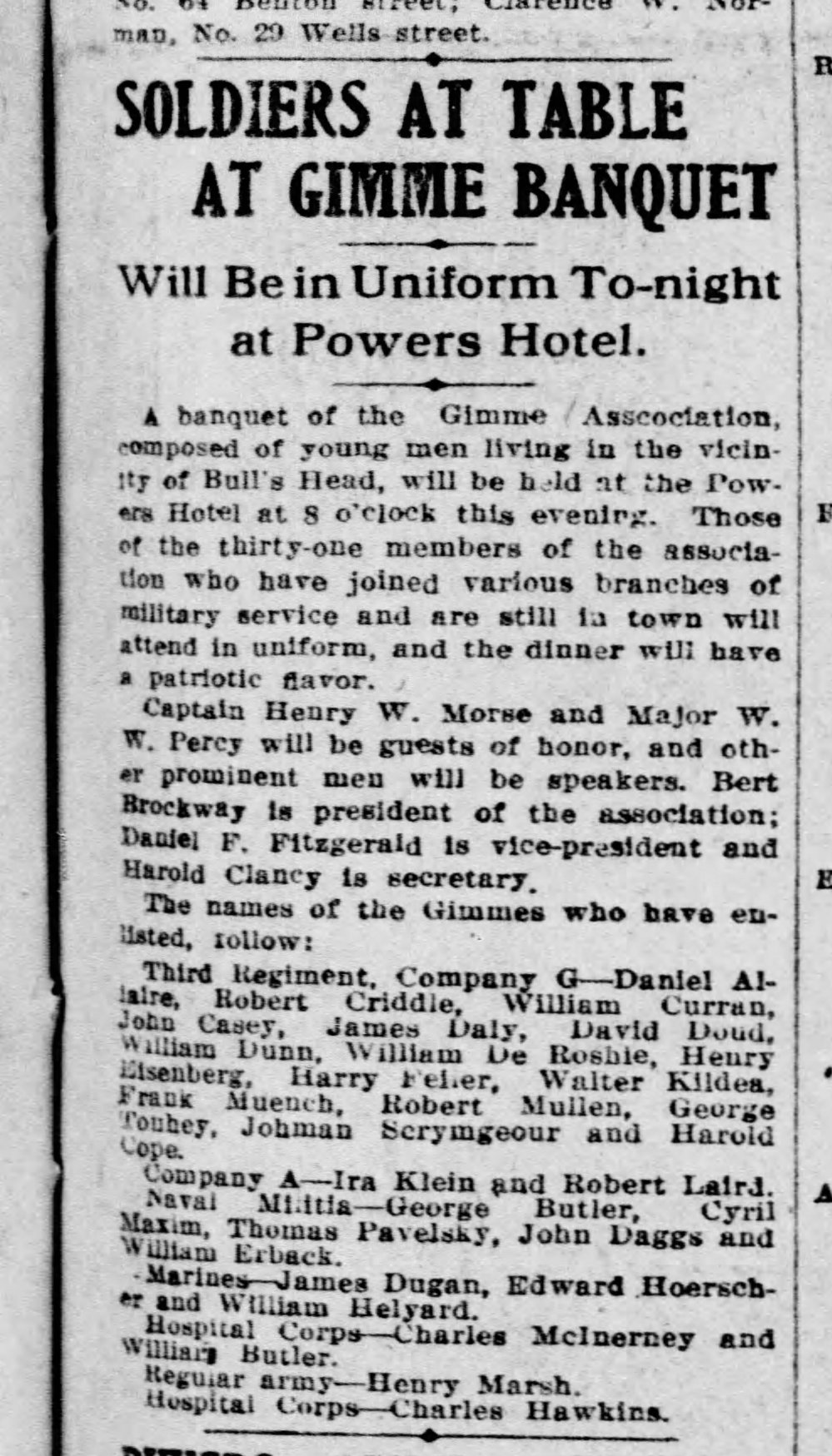
Above from the Democrat and Chronicle from 4/15/1917.

Above from the Democrat and Chronicle from 11/1/1918
Above Above from the Democrat and Chronicle from 11/3/1918.
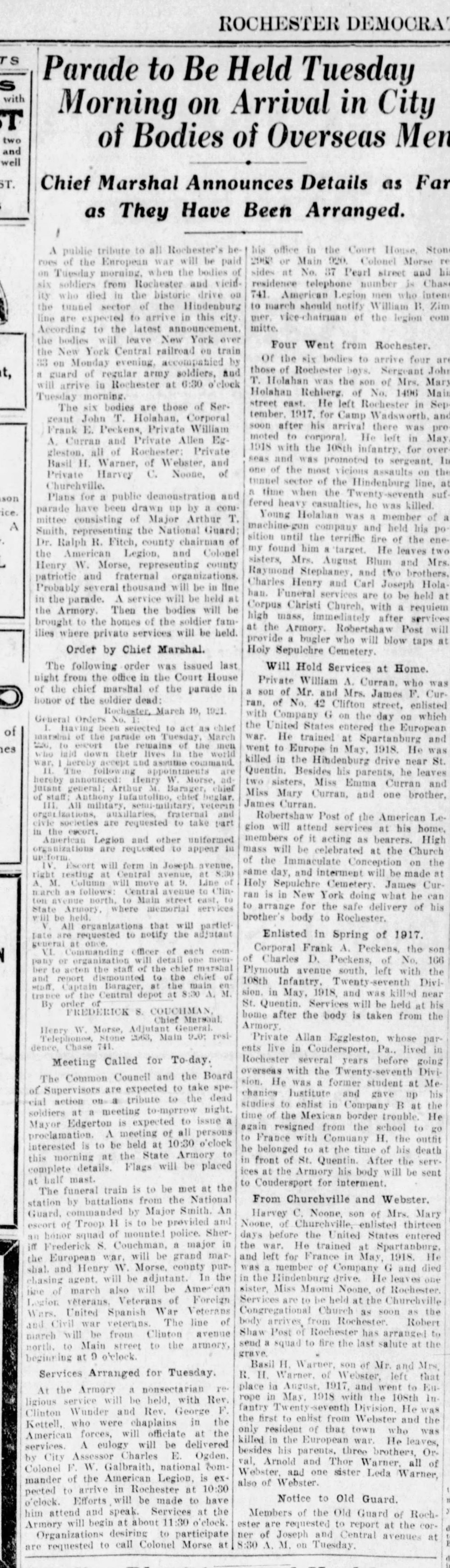
Above from the Democrat and Chronicle from 3/20/1921.

The above is from the Democrat and Chronicle from 3/23/1921
From “World War Service Records Rochester and Monroe County, NY” The Du Bois Press, Rochester, NY – published by the City of Rochester, 1924
© Daniel DeMarle 2018
WALTER RILEY McCARTY
75 Bartlett Street, Rochester, N. Y.
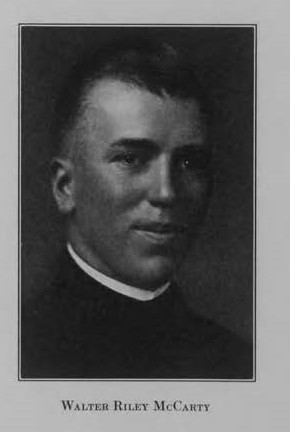 Walter Riley McCarty was born in Rochester, N. Y, May 11, 1890, son of William H. and Amelia McCarty. He was graduated from Immaculate Conception School and West High School, and his name appears on their Honor Rolls. Later he attended Mechanics Institute, and then went to the University of Pennsylvania, where he was graduated as Bachelor of Science. He was employed as an electrician at Rochester, Buffalo, and Philadelphia. He was a member of the Jovian Order of Electricians, and of the Knights of Columbus. Entered the service at Essington, Pa., July 26, 1917, at the age of 27 years, in the Signal Enlisted Reserve Corps, being sent to Cornell University, where he was graduated from the School of Aviation, October, 1917. He was then sent to Ellington Field, Houston, Texas, where he received his commission as 2nd Lieutenant in the 24th Aero Squadron, April 24, 1918; transferred to Post Field, Fort Sill, Okla., where he received orders for foreign service. Embarked overseas, August 9, 1918, arriving in England. He died of broncho-pneumonia, September 20, 1918, at Base Hospital Number 18, Bazoilles, France. First buried in American Cemetery, Number 6, Vosges, France; later his body was brought back to America on the U.S.S. Wheaton, May 18, 1921, and reburied, with military honors, in Holy Sepulchre Cemetery, Rochester, N. Y., May 28, 1921, Lot 305, Sec. R. The bearers were members of the Veterans of Foreign Wars. Delegations from Rochester Council Number 178, Knights of Columbus, attended the service. Lieutenant McCarty’s brother, William Henry McCarty, served as a First Lieutenant in the 374th Infantry.
Top left article from the Democrat and Chronicle on 10/20/1918. Top right article from the Democrat and Chronicle on 1211/1918. Middle right article from the Democrat and Chronicle on 5/27/1921, and Bottom article from the Democrat and Chronicle on 5/29/1921.


From “World War Service Records Rochester and Monroe County, NY” The Du Bois Press, Rochester, NY – published by the City of Rochester, 1924
© Daniel DeMarle 2018
I was recently reminded by one of my female college friends about her rape by another student. Since this was around 35 years ago, it immediately made me think of Dr. Ford and her assault. Honestly I had forgotten my friend’s rape. I know how bad this sounds, but it clearly never came up in my mind anytime in lets say, the last 25 to 30 years.
It occurred after a party I attended. The rapist was someone I had seen in the college bar scene. To say I knew him socially would be a vast exaggeration. We were vague acquaintances. The rape occurred after I had left the party. She told me about it some months later. Being a college student, I am sure I tried to offer some good advice but I am not even sure what advice I gave. I knew I was angry and hurt and my male pride was injured that I was there and could not protect her. I believe I offered to go and hurt the rapist, but she asked me not to, and also asked me not to tell.
So there it lay. Now, however, like Dr. Ford I try to put the pieces back together. I would tell you his name, but I honestly don’t remember it. I have a hard time coming up with his physical description, long brown hair, a white guy. We drove back and forth to the party. Where was it? I didn’t drive? Who drove? What car? What was the house like? Vague memories of white paint. A kitchen but I spent lots of times at parties in kitchens. What year? Maybe my freshman year, maybe my Sophomore year, probably not my Junior year, because I think I remember walking away from town after she told me. What time of year? I think I remember winter. Of course going to college in Western NY, that could be either the Fall or Spring semesters.
Now if I could talk with others, I could probably narrow down the possibilities, and I am sure she remembers more. But that is the way memory works.
Which brings us to the news media and politics. Memory science is not an unknown factor. There are many researchers who could totally have testified to a Congress that actually cared about memory. There are sex abuse experts who could totally have testified lucidly and knowledgeable about memory and PTSD. There are other people who could have testified about events surrounding Dr. Ford, and Judge Kavanaugh, as well as about what happened to my friend. That may have totally have aided my memory and recall. But they were never asked, the microphone was silent. There was no desire to seek out the truth or to learn the facts. The whole thing was an orchestrated sham.
So what then about the news media? I assume that some reporters interviewed some of these experts. I never saw those reports or news stories, in the pages and pages and hours of coverage I listened to. I heard lots of she said, he said, and lots of character assignations. I did not really see, read, or hear a news media that had a strong desire to uncover and report that truth. The fact is in terms of the X files, “the truth is out there”. So where are the politicians and reporters who actually want to find it, uncover it, learn it, and in the case of the news media, report it.
© by Dan DeMarle 2018

© photo by Daniel DeMarle 2018

Now that Judge Kavanaugh has been appointed 22% of the Supreme Court Justices have been accused of sexual misconduct. 40% of the Republican Supreme Court members have been accused of sexual misconduct. 33% of the men on the Supreme Court have been accused of Sexual Misconduct. In both cases more than one women had accusations. In both cases the white Republican Senators (two of them where there for both hearings) did not want to hear from them. In both cases the women were calm and professional. In both cases the men lost control and used anger to attack their accusers. In both cases they used their own privilege as men to suppress women.
Do you think that composition can provide Justice to the people of the Unites States? Do you think that with 1/5th of the Supreme Court having been credibly accused of sexual misconduct that, women will get a fair hearing.? Of course, this is all on top of the fact that 100% of the current President is accused of sexual assault.
Of course you have the power to change this. VOTE!, Get you friends, acquaintances, family members, and neighbors to vote! Vote every Republican out of office. Vote Women into office.
© by Dan DeMarle
John Henry Lehnen was born in Rochester, N. Y., April 5, 1888, son of John and Minnie Lehnen. He was graduated from West High School, Class of 1908, and later attended the University of Rochester, being in the Class of 1912. He was well known as a football player. At the time of the World War he was employed as a law clerk in the office of Charles E. Bostwick. Entered the service at Rochester, N. Y, April 2, 1918, at the age of 30 years, as a Private, being assigned to the 11th Company, 3rd Training Battalion, 153rd Depot Brigade; transferred to Company B, 310th Infantry, April 25, 1918. He was trained at Camp Dix, Wrightstown, N. J. Embarked over seas, May 19, 1918, arriving at Folkstone, England. Transferred, August 12, 1918, to Headquarters Company, 3l0th Infantry. Engaged in action in the St. Mihiel Drive, at Thiaucourt. Killed in action, September 19, 1918, at Thiaucourt. Buried in Thiaucourt Cemetery, France. Private Sam Harris, of Rochester, N. Y., a member of Headquarters Company, 310th Infantry, was with Private Lehnen at the time he was killed and reported that they were both returning from a communicating trench, when they ran into enemy shell-fire, but managed to escape behind a mound; then a bursting shell landed only a few feet away, killing Private
Lehnen instantly and slightly wounding Private Harris.
From “World War Service Records Rochester and Monroe County, NY” The Du Bois Press, Rochester, NY – published by the City of Rochester, 1924
© Daniel DeMarle 2018
 leavingleavesineaves