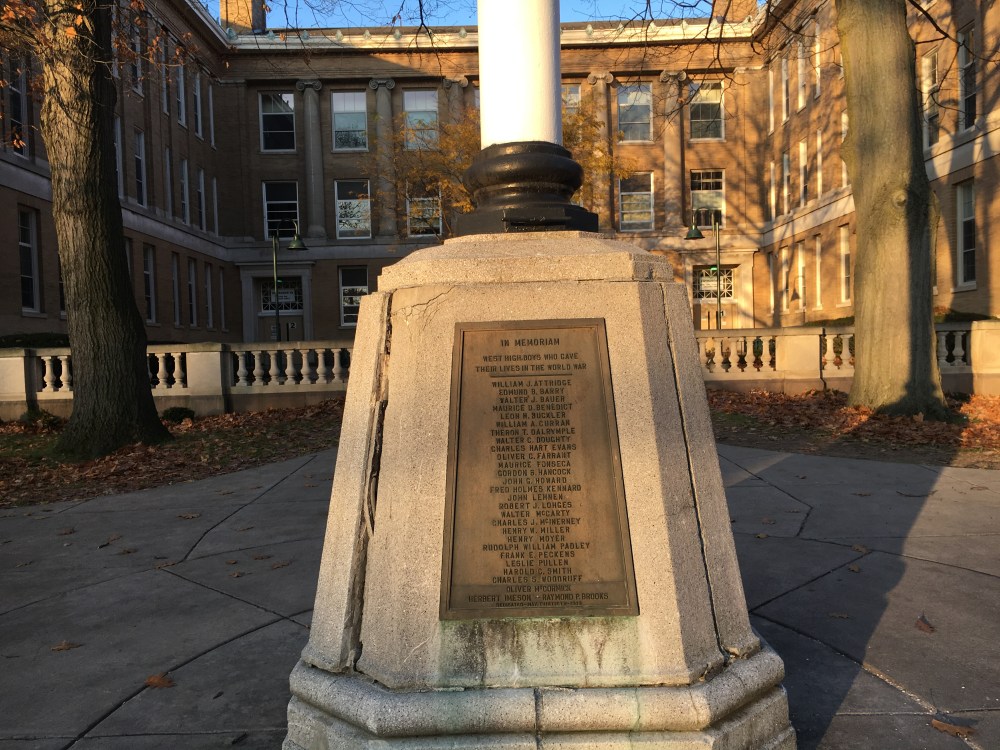
Wilson High School World War I Memorial: John Henry Lehnen 4/5/1888 – 9/19/1918

John Henry Lehnen was born in Rochester, N. Y., April 5, 1888, son of John and Minnie Lehnen. He was graduated from West High School, Class of 1908, and later attended the University of Rochester, being in the Class of 1912. He was well known as a football  player. At the time of the World War he was employed as a law clerk in the office of Charles E. Bostwick. Entered the service at Rochester, N. Y, April 2, 1918, at the age of 30 years, as a Private, being assigned to the 11th Company, 3rd Training Battalion, 153rd Depot Brigade; transferred to Company B, 310th Infantry, April 25, 1918.  He was trained at Camp Dix, Wrightstown, N. J. Embarked over seas, May 19, 1918, arriving at Folkstone, England. Transferred, August 12, 1918, to Headquarters Company, 3l0th Infantry. Engaged in action in the St. Mihiel Drive, at Thiaucourt. Killed in action, September 19, 1918, at Thiaucourt. Buried in Thiaucourt Cemetery, France. Private Sam Harris, of Rochester, N. Y., a member of Headquarters Company, 310th Infantry, was with Private Lehnen at the time he was killed and reported that they were both returning from a communicating trench, when they ran into enemy shell-fire, but managed to escape behind a mound; then a bursting shell landed only a few feet away, killing Private
Lehnen instantly and slightly wounding Private Harris.

From “World War Service Records Rochester and Monroe County, NY” The Du Bois Press, Rochester, NY – published by the City of Rochester, 1924

© Daniel DeMarle 2018

Where the h&^^ is our representation?

New data points out that children in SW Rochester including the 19th ward are unduly hindered by poverty.  If a child grows up poor in SW Rochester they will earn on average less than <$20,000, that same child growing up in a suburb will earn on average >$50,000.  The data are striking, scary, and telling.  How children do in SW Rochester vary considerably in the same streets by whether they are white, black, Asian, or Hispanic.  But regardless of race they are all doing worse than their suburban peers.  That should not be.

So while that is bad enough, the question I ask, is where the hell is our political representation?  Where are the people fighting for us, to fix this.  Well currently those of us in SW Rochester are getting screwed.  We are getting screwed because our State Assembly person, David Gantt, is sick. Due to that fact in 2017 he only attended sessions in Albany for 36.5 percent of the time “He was present for 23 of the Assembly’s 63 session days, according to the house’s records.” In 2018 he only attended four days.  There is no way Assembly person Gantt can fight for his constituents in SW  Rochester with that record. As  he was reelected in the primary in September that state will not change.

Sadly we also lost, US Representative, Louise Slaughter this year.  however, because Governor Cuomo, decided not to appoint someone to her seat, we have had no representation in the US House of Representatives since her death.

What we are left with, therefore, are two of our most important political seats being essentially vacant in one case, and literally vacant in the other.  We are in a state of “taxation without representation.”  This is unacceptable!  So the question is, where is the outcry?

© Daniel DeMarle 2018


Wilson High School World War I Memorial: Leon H. Buckler 1-8-1894 – 9-19-1918

LEON H. BUCKLER
180 Driving Park Avenue, Rochester, N. Y.
1/8/1894 – 9/19/1918

Army_distinguished_service_cross_medalDemocrat_and_Chronicle_Thu__Jun_2__1921_

Leon H. Buckler was born in Farmington, N. Y., January 6, 1894, son of John A. and Addie (Hamilink) Buckler. He attended Public School Number 20, and West High School, Rochester, N. Y., and was a member of the class of 1917, University of Rochester. His name appears on the Memorial Tablet, dedicated in Public School Number 20, June 14, 1922; and also on the Honor Roll of the Church of the Ascension. He embarked overseas with the American Ambulance Corps, December 16, 1916, and served with the French Army until the American soldiers crossed from America.  He then joined his own countrymen. He entered the service in United States Army, August 29, 1917, at Mayen, France, in 4th Section, 627, Ambulance Service. His work was to look after wounded soldiers, and get them to various hospitals. He was promoted to Corporal, and on October 25, 1917, to Sergeant, 1st Class. He died of pneumonia, September 19, 1918, at Urbes, France. He was first buried at Urbes, France; later his body was brought back to America and reburied in Mt. Hope Cemetery, Rochester, N. Y., June 1st, 1921, All 1, R-8, Grave 15.
He was awarded the French Croix de Guerre with bronze star, (Posthumous Award) under order Number 12,000, D, dated, November 29, 1918, General Headquarters, French Armies of the East, with the following citation:

“A model of coolness and untiring activity. During the combats from July 18 to 28th, 1918, he effected the evacuation of the regimental wounded in perfect manner without rest and indifferent to the artillery fire raging around the first-aid station.”

From “World War Service Records Rochester and Monroe County, NY” The Du Bois Press, Rochester, NY – published by the City of Rochester, 1924

Democrat_and_Chronicle_Wed__Jun_25__1913_


© Daniel DeMarle 2018

Wilson High School World War I Memorial: Edmund Burton Barry 9/5/1898 – 8/20/1918

EDMUND BURTON BARRY
52 Cady Street, Rochester, N. Y.
9/5/1898 – 8/20/1918

Democrat_and_Chronicle_Sat__Aug_24__1918_

Edmund Burton Barry was born in Rochester, N. Y., September 5, 1898, son of Edmund Parker and Charlotte M. Barry. He attended Public Schools, Numbers 3 and 4, and West High School, where he was prominent in athletics and captain of the basketball team. He was a member of Brick Presbyterian Church and Sunday School. He entered the service at Rochester, N. Y., April 7, 1917, in the United States Naval Reserve Force, as Apprentice Seaman, at the age of 18 years, and was sent to Philadelphia, Pa. He served on the U.S.S. Granite State, from April 20, 1917, to May 11, 1917; at the Naval Air Station, Bay Shore, Long Island, from May 11, 1917, to December 12, 1917; Naval Air Station, Key West, Florida, from December 17, 1917, to March 3, 1918. He was promoted to Chief Quartermaster, February 16, 1918, and was commissioned Ensign, and appointed a Naval Aviator, on March 3, 1918, assigned to duty, Naval Air Station, Key West, Florida. He was Apprentice Seaman, 302 days and Chief Quartermaster, 14 days. On March 6, 1918, he was transferred from Key West to Washington, D. C, for temporary duty; thence to Aviation Forces, France; April 25, 1918, reported to Aviation Forces and to Naval Air Station, Moutchic-Dacanau, France (Gironde); later stationed at St. Trojan.

He died, August 20, 1918, at St. Trojan, France, as a result of a bomb explosion on a seaplane. Ensign Barry was one of the Coast Patrol Fliers when a request for aid was wirelessed from a torpedoed ship. As the fliers were starting the machine down the runway toward the water to go to the ship’s help, one of the bombs dropped by accident exploding 200 pounds of T.N.T., which bomb exploded another in the rack killing Barry instantly together with fifteen others in the immediate vicinity. He was first buried at St. Trojan, France; removed, October 24, 1921, and received at Paris, November 22, 1921; reburied in Suresnes Cemetery, May 4, 1922, where he remains. Another Rochester boy, Walter Sparrboom, Jr., is buried near Ensign Barry. These two boys were in the same Sunday School Class at Brick Church.

Ensign Barry was accounted one of the most able naval fliers in European waters. He was a member of the Aero Club of America, and the Army and Navy Club of America.

On September 15, 1918, a gold star, the first one, that of Ensign Barry, was added to the Service Flag at the Brick Presbyterian Church, of Rochester, N. Y. The pastor, Rev. William R. Taylor, D. D., offered the following tribute:

“There is a gold star on our Service Flag this morning, the first to be placed there. We hardly dare hope that it will be the last. ” It is in proud and loving memory of Ensign Edmund Burton Barry, of the Aviation Section of the United States Navy, who was killed by the accidental explosion of a bomb on August 20th last.

“The fineness and strength of his character were shown in the circumstances of his enlistment. On Good Friday of last year war was declared. The next day this lad of eighteen, still a pupil in the West High School, where he had been a leader in athletic sports, went by himself and offered his services to the Navy. That night he told his parents what he had done in obedience to the sense of duty which pressed irresistibly upon him. In his bed-chamber that night father, mother and only son talked together
until the small hours of the morning, all joining sorrowfully and yet triumphantly in the sacrifice. The next day, Easter Sunday, the father signed the necessary papers and on the following day the lad was gone! So quickly was the momentous business accomplished.

“If the manner of his enlistment revealed anything of his spirit his brief career following revealed even more. Entering the service as a common Seaman, he aspired to something higher, and within a year and a few days of his enlistment he had completed the very difficult course of training prescribed for naval aviators, winning his commission as an Ensign two months after he had passed his nineteenth birthday. Early last April he sailed for service in foreign waters.

“His contribution toward the winning of the war was small, but he made it in a great way. His soul took on nobleness from the nobleness of the cause in which he perished. Like Christ, he died for others. To what use more divine could his life have been put?

“Edmund Burton Barry! With sadness, and yet with joy and pride and thankfulness, we inscribe his name at the top of our Honor Roll and change his black star in our Service Flag for the golden one, testifying that he was ‘Faithful unto death.’

” ‘Be thou faithful unto death and I will give thee a crown of life.’ ”

The following verses were written by Ensign Barry’s sister, Mrs. Rena Barry Skerritt, for her brother’s twentieth birthday, September 5, 1918, and were sent to France. He never received them, as he was killed on August 20th:

BROTHER O’ MINE
Brother O’ Mine                                                    You came on a soft
‘Twas years ago                                                  September night,
That we looked, and longed,                         You touched our lives
And prayed for you so.                                With a joyous light.
Our childish hearts                                We loved and were happy,
Sang out, each day,                               And watched you grow,
For a wee bit brother                                    And scolded, as sisters
To come and play.                                           Will as you know.
Now you’re a man
And across the sea
And its waves beat high
In this heart o’ me.
And just as we did
In those days ago
We look, and long
And pray for you so,
Brother O’ Mine!
O Brother O’ Mine!

After receiving the news of her brother’s death Mrs. Skerritt wrote the following:
OUR STAR
Brave, lone Crusader of the skies,
One day when your blest work was done,
In chariot of damask wing
You rode away into the Sun.
A little child, who looks for you
And dreams you, in his Land of Nod
Has ventured that you flew so high
You rode into the arms of God!
And then God loosed a golden star,
And put your spirit there to dwell
Within its place, then turned to us
In pity while the gold star fell.

A letter received from Chaplain Edwin F. Lee said, in part:
“I am sure that a word telling about his burial and the respect shown for him by his comrades, and the French people as well, will be welcome to you.

You have doubtless, ere this, received an official notification of his death which was caused by an accidental explosion, while a hydroplane was being launched. It is one of those things which do not seem to be avoidable in military life, and already seven have succumbed to the injuries received at that time, while others have been more or less seriously injured.

“I was called upon to conduct the burial service for five of these men, on August 22. On the 24th I buried the other two in the cemetery at La Rochelle. Your son sleeps in the little village cemetery on the island near his aviation camp. The entire island was in tears that day. All the Americans were in formation, the French and American Admirals from the nearest headquarters were also in attendance. The French people sent, literally,
loads of flowers and joined with us in the funeral procession. The elderly village priest assisted me in the burial service. I was very happy to have him do this for I thought that some of the men might have come from Catholic homes and, in addition, it was a fine courtesy which the Commanding Officer showed to the village people. I am quite sure that if you had been present you would have found much comfort in the respect which was shown to your son’s body. You may be assured that your son’s life has been expended in a genuine service to humanity. His has been as sacrificial a death as though it had occurred in a spectacular conflict, for it was clearly in the line of duty, and while on his way to assist a ship in distress.”

Democrat_and_Chronicle_Sun__Jan_16__1927_

From “World War Service Records Rochester and Monroe County, NY” The Du Bois Press, Rochester, NY – published by the City of Rochester, 1924


© Dan DeMarle 2018
Wilson High School World War I Memorial: Rudolph William Padley 8/27/1893 – 7/29/1918

WHS Memorial 4

RUDOLPH WILLIAM PADLEY
248 Garfield Street, Rochester, N. Y.
8/27/1893 – 7/29/1918

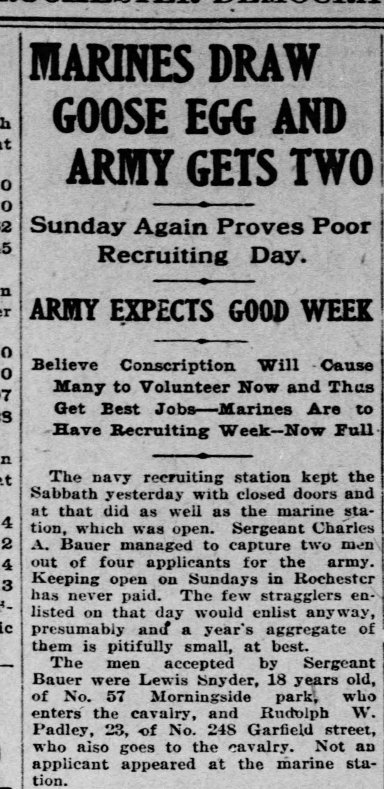
Rudolph William Padley was born in Newark, N. Y., August 27, 1893, son of Henry G. and Mary Padley. He attended West High School, Rochester, N. Y. Before the World War he was employed by the Eastman Kodak Company. Entered the service at Rochester, N. Y., May 3, 1917, at the age of 23 years, as a Private.

1917-4-30 Padley_.jpg

He was sent to Columbus Barracks, Ohio, and assigned to the Cavalry; transferred to Battery B, 76th Field Artillery, August 1, 1917. He was trained at Fort Ethan Allen, Vermont; and Camp Shelby, Hattiesburg, Miss. Promoted to Private, 1st Class, November 1, 1917. Embarked overseas, April 23, 1918. Engaged in action at the Aisne-Marne Defensive Sector.

He was wounded, July 28, 1918, at le Charmel, by a bomb dropped from a German airplane. Died from his wounds, July 29, 1918. Buried at Chateau de Pereuse, Jourare, France.

1918-8-23 Padley died

In 1930, his mother, Mrs. H. G. Padley visited his grave in France. His mother was a very active Gold Star mother and worked on veteran issues in Monroe County.

From “World War Service Records Rochester and Monroe County, NY” The Du Bois Press, Rochester, NY – published by the City of Rochester, 1924

The Democrat and Chronicle reported on 5/26/1930 p. 20 that a memorial tablet was dedicated at West Avenue Methodist Church and this tablet included his name.

1930-7-30 Padleys mother visits grave

from the Democrat and Chronicle 7/30/1930 page 15.

© by Dan DeMarle 2018

Wilson High School World War I Memorial: Thomas Herbert Imeson 4/6/1898 – 7/19/1918

WHS Memorial 5

THOMAS HERBERT IMESON
Barnard, Monroe County, N. Y.
4/6/1898 – 7/19/18

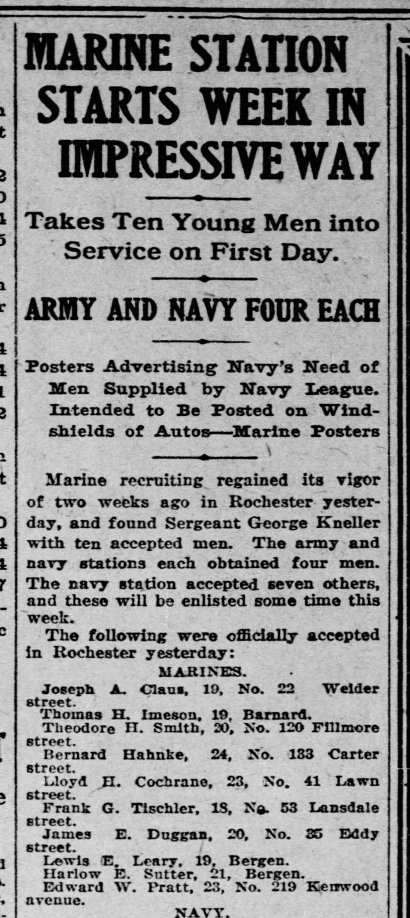
Thomas Herbert Imeson was born in West Troy, N. Y., April 6, 1898, son of Thomas Herbert and Mabel Imeson. He attended West High School, and later was employed by the R. J. Strasenburgh Company. He was step-son of Stanley J. Hawkins. His name appears on the Honor Roll of First Methodist Episcopal Church. Entered the service at Rochester, N. Y., April 7, 1917, at the age of 19 years, as a Private in the United States Marine Corps, being assigned to the 12th Company, 5th Regiment; later transferred to 76th Company, 6th Regiment.

1917-5-1 Imeson recruited

Embarked overseas, July 3, 1917. Engaged in action at Toulon Sector; Aisne Defensive; Chateau-Thierry; Aisne-Marne Offensive. Promoted to Corporal, November 1, 1917. His Regiment was part of the famous Fourth American Brigade, which was cited frequently for desperate bravery.

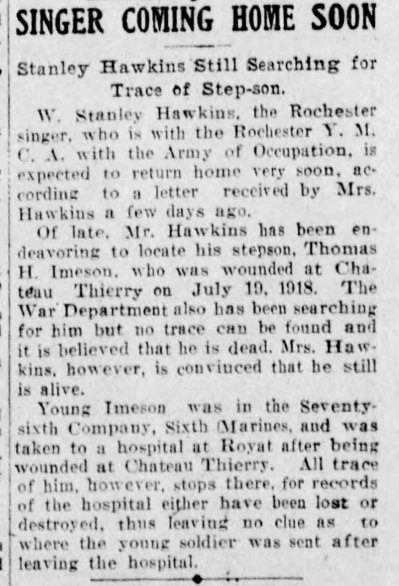
He went into action at Soissons, France, and was not reported after that time. Certificate of presumptive death issued by United States Marine Corps. Official report: “Died of wounds received in action, July 19, 1918.” Place of burial unknown.

1919-7-24 Imeson missing

© by Dan DeMarle 2018