From the Democrat and Chronicle 12/26/1890
Rochester was as Dickensonian as it could be.
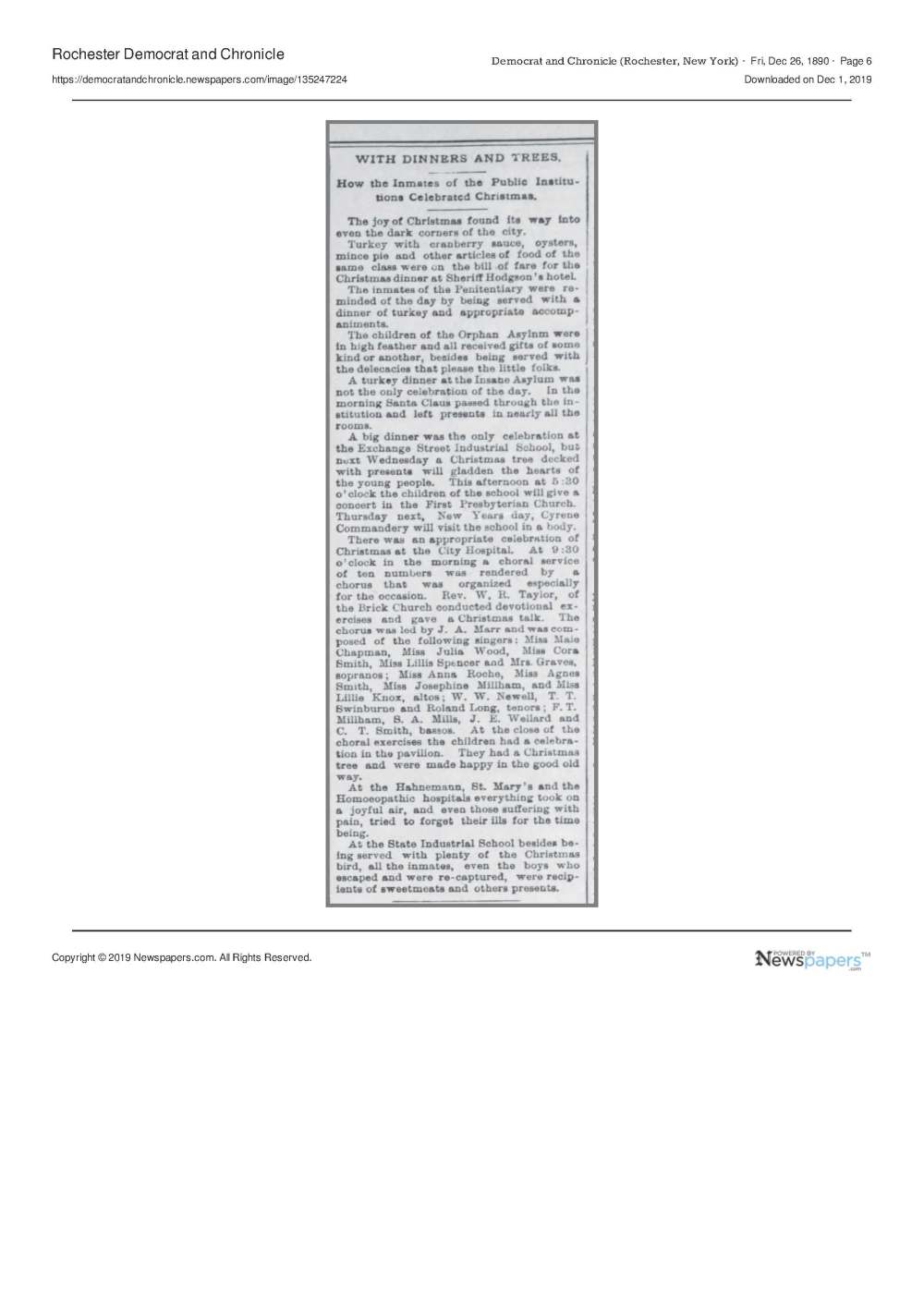
From the Democrat and Chronicle 12/26/1890
Rochester was as Dickensonian as it could be.

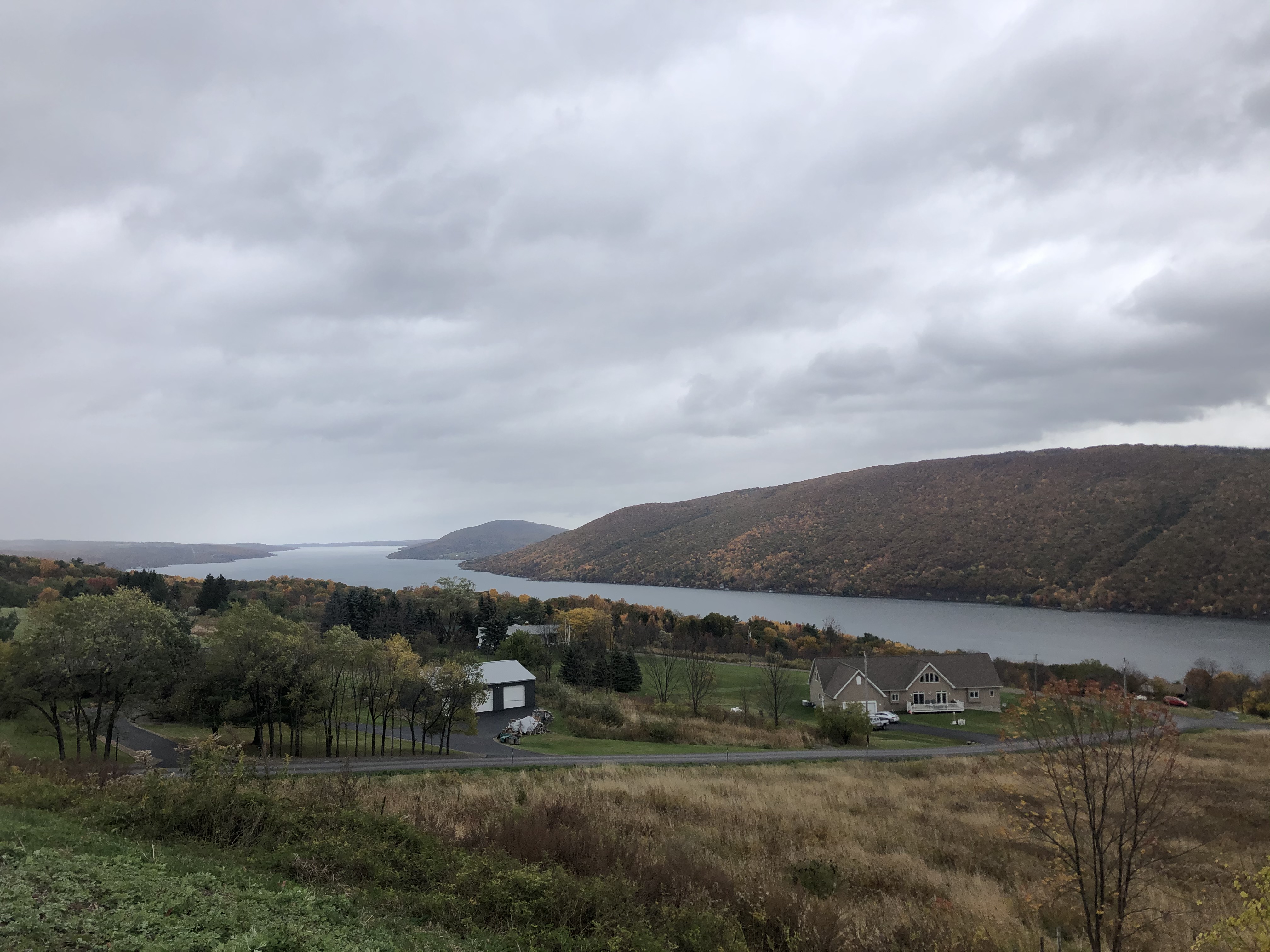
© picture by Dan DeMarle 11/30/2019
I first wrote this in 11/13. It is still very true today
I am Thankful for many things.
Many things many of us take for granted.
The fact that I can breathe and move without pain.
The fact that my body still serves me.
The fact that I do not have an incurable disease.
The fact that I am lucky enough to live in a house, not a shack, hovel, or box on a street.
The fact that my city is not being bombed.
The fact that I do not have to drive through checkpoints on my way to work.
The fact I don’t have to worry about road side bombs
The fact that my daughter is expected to and can go to school.
The fact that I do not have to defecate outside by the side of the road.
The fact that I do not have to worry about parasites in my drinking water.
The fact that I am fortunate enough to be able to afford food.
The fact that I do not have to show I am capable and trying to work to get food stamps from my government.
The fact that I have the freedom to speak against my government.
The fact that over two centuries ago the founders of this country thought a bill of rights was important.
The fact that no one in my immediate family has died from gun violence.
The fact that I happen to have chosen my life partner well, and that I had that choice and it was not forced on me.
The fact that the women in my life can chose what to wear on their heads or their bodies.
Lastly the fact the I am lucky enough to have my family and that I am fortunate enough to call you my friends.
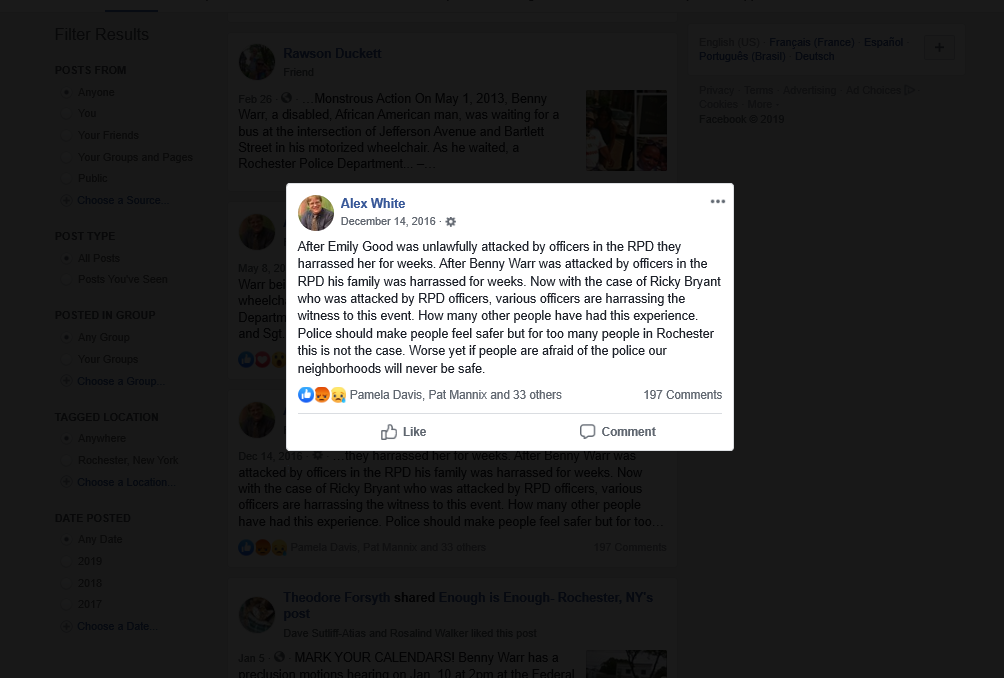
To the Monroe County Legislature, or more particularly the Republicans in that legislature, your blatant racism and political pay back to people in the city is totally obvious. They/we had defeated your incumbent for County executive. They/we had defeated the mostly white police union’s enemy, by voting in the Police Accountability Board. So like Southern racists after Brown, you struck back by passing a racist law. A racist law that will significantly disproportionately impact voters in the City of Rochester. Your proposed law will make it illegal to ANNOY a police officer or other first responder.
So who is more likely to annoy a white male police officer – A white suburbanite or a person of color from the city? But who else? A disabled person taking too much time in answering your question. A black/brown/white woman with an challenging attitude. The male spouse of the man you have pulled over, who tries to video you giving his spouse attitude. The transgender man giving you a look and a little verbal push back who threatens your masculinity. The woman with the hijab trying to ask you questions in an accent that you know should not be here. The upset mother of an assault victim demanding you do something, you know you can not do. The black or Hispanic husband or a white woman who asks too many questions about how the police officer is talking to or looking at his with. The teenager videoing you as you aggressively talk to his/her friends at the bus station, as the officer tells them to move on. In other words, who is most likely to annoy a suburban police officer, the answer is someone not like them. We know how implicit bias works. We know which type of woman gets labeled aggressive when she asks too many questions. We know those people are more likely to live in the city. So we know that this new law is simply racist payback, and my guess is so do you. Disproportionate representation in the prison system happens because of racist laws. You have passed a racist law.
See article – New York County Passes Bill That Could Jail People if They ‘Annoy’ a Cop
© words by Dan DeMarle 2019

Call
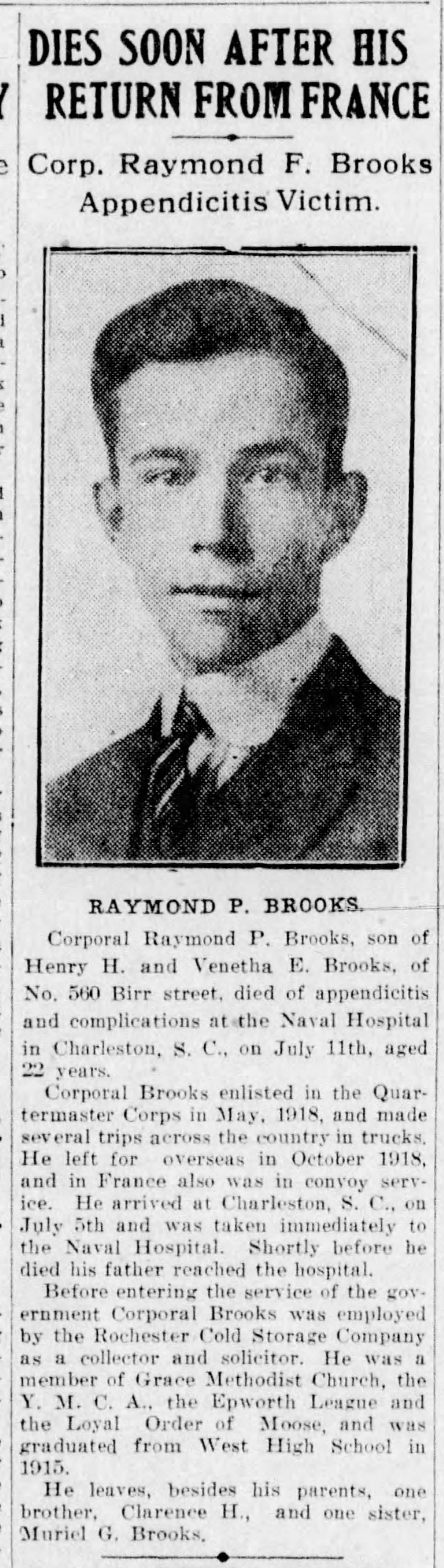
From the Democrat and Chronicle on Tuesday, July 15th 1919.
Raymond P. Brooks was born in Providence, R. I., October 29, 1897, son of Henry H. and Venetta Brooks. He moved to Rochester with his parents at an early age. Here he became a member of Grace Methodist Church, the Epworth League, the Y.M.C.A., and the Loyal Order of Moose. He was graduated from West High School in the class of 1915. He was employed by the Rochester Cold Storage Company as a solicitor and collector. He entered the service, in the Quartermaster Corps, at Buffalo, N. Y., May 25, 1918, at the age of 20 years, as a Private, being assigned to Company E, 106th Supply Train, 31st Division. He was trained at Camp Wheeler, Macon, Georgia. After making
several trips across the country in trucks he embarked overseas, October 21, 1918, on the transport Sobral, and arrived at Brest, France, November 3, 1918. He did convoy duty in France. Promoted to Corporal, November 12, 1918. The last four months of his stay in France, he drove a bus between Paulhos and Bordeaux. He re-embarked for America, the latter part of June, 1919, on the transport Cape May. On the way home volunteers were called for to shovel coal and he was one of the first to respond, but three days before landing he was taken with acute appendicitis. He reached Charleston, S. C, July 5, 1919, and was taken to the Naval Hospital, where he died of general peritonitis, following an operation, July 10, 1919. He was buried in Elmwood Cemetery, Batavia, N. Y., Lot number 321.
from World War Service Record Rochester and Monroe County, NY, The Du Bose Press, Rochester, NY – published by the City of Rochester, 1924.
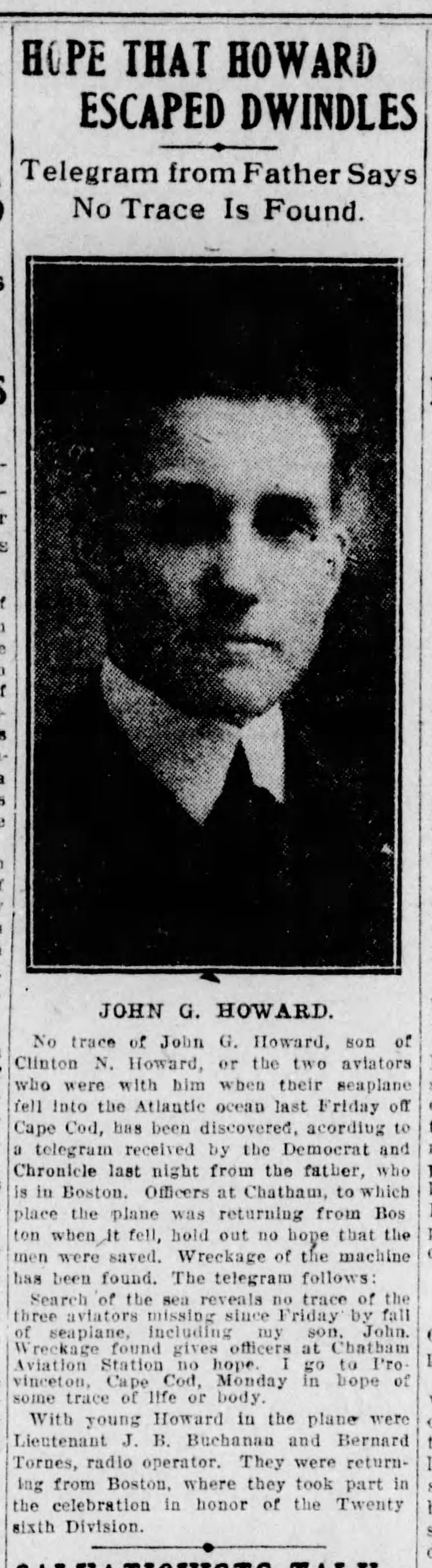
From the Democrat and Chronicle on Monday, April 28th, 1919
John Gough Howard was born in Rochester, N. Y, May 18, 1897, son of Clinton N. and Angeline M. (Kellar) Howard. His name appears on the Honor Roll of the Lake Avenue Baptist Church. He was graduated from West High School, and entered Amherst College in the fall of 1915. Entered the service at Boston, Mass., June 1, 1918, at the age of 21 years, as a Student Volunteer, in the United States Naval Air Service. He was stationed at the Naval Aviation Detachment, Massachusetts Institute of Technology, from June 6, 1918, to August 19, 1918; at the Naval Air Station, Bay Shore, L. I., to September 25, 1918; on receiving ship, Pensacola, Florida, to November 11, 1918. Commissioned Ensign, Pensacola, Florida, December 28, 1918.
On April 25, 1919, he was lost at sea in a hydroplane, off the Coast of Cape Cod, near Provincetown, Mass. Chimes, composed of six teen harmonic bells, were placed in the belfry at the Lake Avenue Baptist Church in memory of Ensign Howard, the gift of bis father, Rev. Clinton N. Howard, who paid to his son the following tribute, at Memorial Service, June 4, 1919:
“Had John lived until May 18th, three weeks after the tragedy that ended his life by the wreck of his hydro-aeroplane at sea off the New Eng land coast, he would have been twenty-two years old.
“The picture of John is as his friends at home knew him at the time of his graduation from West High School. He was then eighteen.
“He had already chosen his life-work, entering Amherst College in the fall of 1915 to lay the foundation for a study in international law, with an ambition to fit himself for the Diplomatic Service.
“Recognizing America’s new place in world affairs he said to me, ‘We will need trained men in this larger field of service.’
“The talents which won him honors at High School were early recognized at Amherst, where he won the Oratorical Endowment Prize in his Freshman year. In his Sophomore year he was managing and associate editor of the Student, chairman of Membership Committee, Christian Association, member of the Student Council, manager of the Press Bureau, secretary of the Students’ Association, and member of the Delta Kappa Epsilon Fraternity.
“He enlisted in the Naval Aviation as a student volunteer after the declaration of war, and received his commission at Pensacola in December following.
“On April 25th (1919) he, with two brother officers, was ordered to make the flight to Boston in a raging wind, as part of the welcome home of the Twenty-sixth Division, and on the return flight to Chatham Air Station the plane went into the sea in one of the fiercest storms of the winter.
“Parts of the wrecked plane were washed up upon the beach several days after, but no trace of the men was ever found.
“The last news came by carrier pigeon, dated at 2:20 p. m., an eight-word message, which stated that they were in the sea.
“Thus ended the earthly career of a promising and patriotic young American who, from choice, interrupted his college career to defend the flag and fight for the ideals of democracy.
“He was a precious son. In the twenty-two years of his life he never gave us an hour of pain or concern. He was loyal, self-reliant, loving and devot edly Christian. He was a white-souled son. ‘Don’t worry about me,’ he said, when he enlisted, ‘I’ll come out of the service as clean as I go in.’ That is the testimony of all his companions. He formed no new habits.
“His letters gave evidence of a deepening of his spiritual life. ‘Among the clouds,’ he wrote, “I feel that I am in the presence of God. It is like flying to heaven.’ I saw him two weeks before his last flight. That night he put his arms lovingly around me and said, ‘Pop, you’re a prince. I’ll be home for good on my birthday, and some day I’ll pay you back and make you proud that I’m your son.'”
‘Home for good’ on his birthday he was ! I have joy in his memory and consolation in the confidence that he is with his dear mother and sister in the Home above.
“I am sending this memorial to his friends who loved him, and as an acknowledgment to those who have helped sustain me with their sympathy while I waited in hope for the son who returned not.
“As I searched the ocean beach off the bleak coast of Cape Cod for some possible evidence of his escape on the day after the storm that carried his plane out to sea, I wrote the prayer poem which follows:
“Farewell, my John, but not for long! ‘He cannot come to me, but I
can go to him.’ ”
GIVE BACK MY SON
Only begotten Son of God,
Whose feet the troubled waters trod,
Whose gentle voice once calmed the sea
On storm-tossed lake of Galilee,
Hear Thou a father’s earnest plea:
And bring back my son John to me.
Master of storm and wind and wave,
Thou who, when the mad tempest raged,
And Thy distressed disciples prayed,
Cried, “Peace, be still!” to the wild sea
In my distress I cry to Thee:
Bring back my first-born son to me.
Oh, Christ, my Lord, at whose command
The sea became safe as the land,
Whose word the stormy waves obeyed
When sinking Peter cried, “Lord, Save!”
Command Thou now this raging sea
And send back home my John with me.
Not alone for my selfish joy
Would I recall my soldier boy
Back again to this world of pain;
Only to glorify Thy Name
I would have him live once again,
That he might serve his fellow men.
Bone of my bone, my first-born son,
Blood of my blood, my precious one,
What boundless joy thou wert to me!
How sacred is thy memory!
Would God that I had died for thee,
Oh, John my son, how can it be!
Underneath the picture of his lost lad, Mr. Howard printed these
lines from Whittier:
“Yet love will dream, and Faith will trust,
That somehow, somewhere, meet we must.
Alas for him who never sees
The stars shine through his cypress trees !
Who, hopeless, lays his dead away,
Nor looks to see the breaking day
Across the mournful marbles play !
Who hath not learned, in hours of faith,
The truth to flesh and sense unknown,
That Life is ever lord of Death,
And Love can never lose its own!”
from World War Service Record Rochester and Monroe County, NY, The Du Bose Press, Rochester, NY – published by the City of Rochester, 1924.
There is no evolutionary reason for female orgasm. A man has to procreate in order to deliver sperm and create a new person. A woman’s orgasm is not tied to procreation. It is this fact that has led to men greatly fearing woman’s sexuality and drives most of the reasons for men enforcing patriarchy. In other words, men suppress woman because they fear female orgasm and enforce rules to control woman’s sexuality such as the insistence on chastity and virginity before marriage and father’s and mother’s enforcing purity rings and pledges.
Not all penises are the same, not all men are good lovers. That is the last thing insecure men want woman to know. If a woman marries an inadequate man, and that man is her only lover, the man will not lose the woman. She knows nothing else. If a woman has sexual experience and then finds an inadequate man, she may still chose to marry him for all kinds of reasons, but he knows, that she knows that he is inadequate. She may then search for more pleasure with better lovers after the marriage.
The whole goal of enforcing chastity and virginity is to keep woman from being able to judge the physical and practical inadequacy of their future spouse.
© words by Dan DeMarle 2019
The tip of Seth Green Island in the lower Genesee River.

©️photo and words by Dan DeMarle 10/2019
 leavingleavesineaves