 While NY was still a slave State, Rochester was the residence of a remarkable African American, named Asa Dunbar. For a little history, the first slave auction in what would become NY State was held in 1655, when we were still New Amsterdam. The last slaves in NY State were freed on July 4, 1827. Also, a little known fact, for Hamilton fans, is that Aaron Burr was a driver in outlawing slavery in NY.
While NY was still a slave State, Rochester was the residence of a remarkable African American, named Asa Dunbar. For a little history, the first slave auction in what would become NY State was held in 1655, when we were still New Amsterdam. The last slaves in NY State were freed on July 4, 1827. Also, a little known fact, for Hamilton fans, is that Aaron Burr was a driver in outlawing slavery in NY.
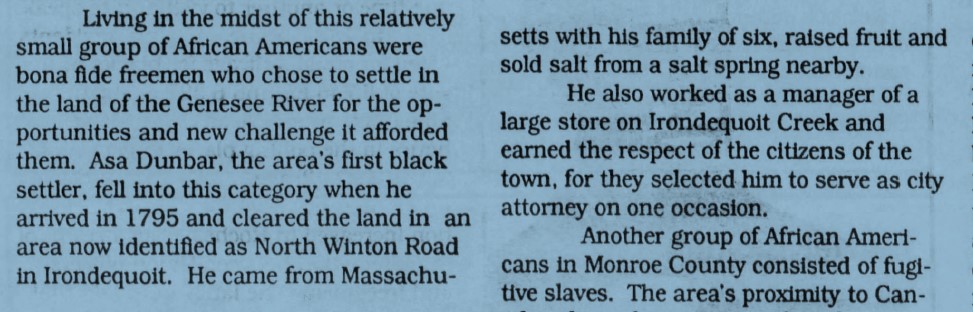
Asa Dunbar, was black, but many accounts refer to him as a mulatto. He is reported to have moved to the Rochester area in 1795 and to have had a successful farm for his family of six near what is now North Winton Road. He is also possibly the first black elected official in the State, or certainly in this part of Western NY. He was at one point selected by his fellow citizens to serve as City attorney on at least one occasion.
Mary Jo LanphearTown of Brighton Historian wrote about Asa in 2/7/2010. also has done research on Asa and published his research on 1/15/2017 and on 1/16/2017.


The article below is from the Democrat and Chronicle on 2/2/1991

© words by Dan DeMarle 2/2020



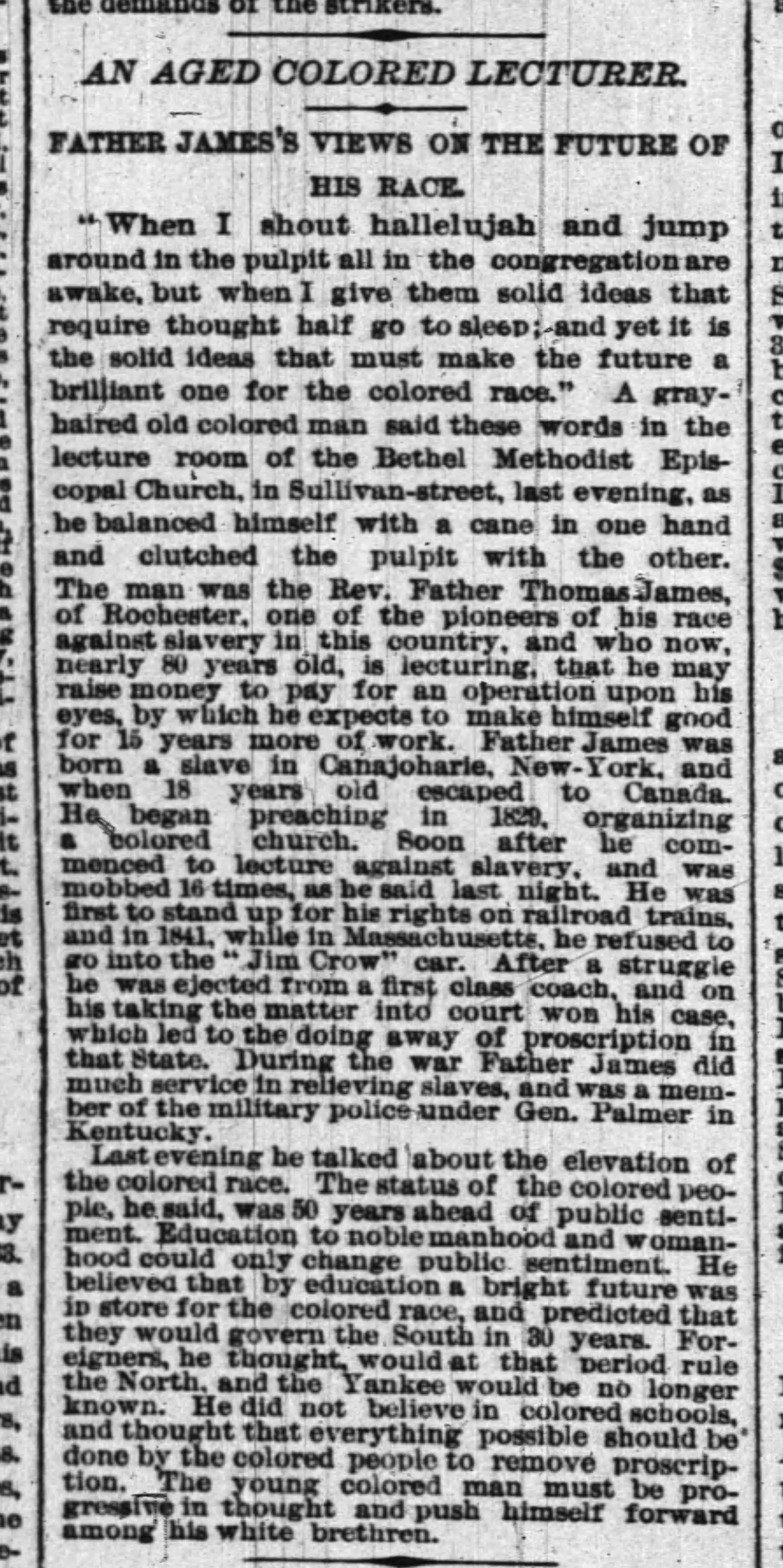 As the NY Times reported on 7/25/1884 “The man was Rev. Father Thomas James of Rochester, one of the pioneers of the race against slavery in this country, and who now nearly 80 years old, is lecturing, that he may raise money to pay for an operation upon his eyes, by which he expects to make himself good for 15 years more of work. Father James was born a salve in Canajoharie, New-York, and when 18 years old escaped to Canada. He began preaching in 1829, organizing a colored church. Soon after he commenced to lecture against slavery, and was mobbed 16 times, as he said last night. He was first to stand up for his rights on railroad trains, and in 1841, which in Massachusetts, he refused to go into the “Jim Crow” car. After a struggle, he was ejected from a first class coach, and on his taking the matter into court won his case, which led to the doing away of prescription in that State. During the war (the Civil War) Father James did much service in relieving slaves, and was a member of the military police under Gen. Palmer in Kentucky.”


 leavingleavesineaves