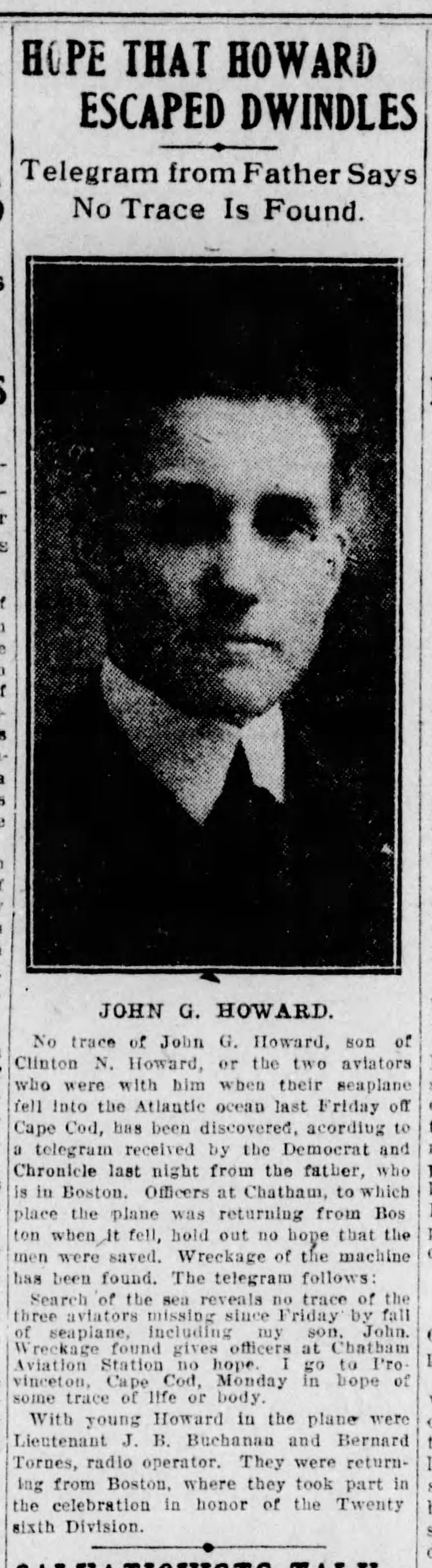
From the Democrat and Chronicle on Monday, April 28th, 1919
John Gough Howard was born in Rochester, N. Y, May 18, 1897, son of Clinton N. and Angeline M. (Kellar) Howard. His name appears on the Honor Roll of the Lake Avenue Baptist Church. He was graduated from West High School, and entered Amherst College in the fall of 1915. Entered the service at Boston, Mass., June 1, 1918, at the age of 21 years, as a Student Volunteer, in the United States Naval Air Service. He was stationed at the Naval Aviation Detachment, Massachusetts Institute of Technology, from June 6, 1918, to August 19, 1918; at the Naval Air Station, Bay Shore, L. I., to September 25, 1918; on receiving ship, Pensacola, Florida, to November 11, 1918. Commissioned Ensign, Pensacola, Florida, December 28, 1918.
On April 25, 1919, he was lost at sea in a hydroplane, off the Coast of Cape Cod, near Provincetown, Mass. Chimes, composed of six teen harmonic bells, were placed in the belfry at the Lake Avenue Baptist Church in memory of Ensign Howard, the gift of bis father, Rev. Clinton N. Howard, who paid to his son the following tribute, at Memorial Service, June 4, 1919:
“Had John lived until May 18th, three weeks after the tragedy that ended his life by the wreck of his hydro-aeroplane at sea off the New Eng land coast, he would have been twenty-two years old.
“The picture of John is as his friends at home knew him at the time of his graduation from West High School. He was then eighteen.
“He had already chosen his life-work, entering Amherst College in the fall of 1915 to lay the foundation for a study in international law, with an ambition to fit himself for the Diplomatic Service.
“Recognizing America’s new place in world affairs he said to me, ‘We will need trained men in this larger field of service.’
“The talents which won him honors at High School were early recognized at Amherst, where he won the Oratorical Endowment Prize in his Freshman year. In his Sophomore year he was managing and associate editor of the Student, chairman of Membership Committee, Christian Association, member of the Student Council, manager of the Press Bureau, secretary of the Students’ Association, and member of the Delta Kappa Epsilon Fraternity.
“He enlisted in the Naval Aviation as a student volunteer after the declaration of war, and received his commission at Pensacola in December following.
“On April 25th (1919) he, with two brother officers, was ordered to make the flight to Boston in a raging wind, as part of the welcome home of the Twenty-sixth Division, and on the return flight to Chatham Air Station the plane went into the sea in one of the fiercest storms of the winter.
“Parts of the wrecked plane were washed up upon the beach several days after, but no trace of the men was ever found.
“The last news came by carrier pigeon, dated at 2:20 p. m., an eight-word message, which stated that they were in the sea.
“Thus ended the earthly career of a promising and patriotic young American who, from choice, interrupted his college career to defend the flag and fight for the ideals of democracy.
“He was a precious son. In the twenty-two years of his life he never gave us an hour of pain or concern. He was loyal, self-reliant, loving and devot edly Christian. He was a white-souled son. ‘Don’t worry about me,’ he said, when he enlisted, ‘I’ll come out of the service as clean as I go in.’ That is the testimony of all his companions. He formed no new habits.
“His letters gave evidence of a deepening of his spiritual life. ‘Among the clouds,’ he wrote, “I feel that I am in the presence of God. It is like flying to heaven.’ I saw him two weeks before his last flight. That night he put his arms lovingly around me and said, ‘Pop, you’re a prince. I’ll be home for good on my birthday, and some day I’ll pay you back and make you proud that I’m your son.'”
‘Home for good’ on his birthday he was ! I have joy in his memory and consolation in the confidence that he is with his dear mother and sister in the Home above.
“I am sending this memorial to his friends who loved him, and as an acknowledgment to those who have helped sustain me with their sympathy while I waited in hope for the son who returned not.
“As I searched the ocean beach off the bleak coast of Cape Cod for some possible evidence of his escape on the day after the storm that carried his plane out to sea, I wrote the prayer poem which follows:
“Farewell, my John, but not for long! ‘He cannot come to me, but I
can go to him.’ ”
GIVE BACK MY SON
Only begotten Son of God,
Whose feet the troubled waters trod,
Whose gentle voice once calmed the sea
On storm-tossed lake of Galilee,
Hear Thou a father’s earnest plea:
And bring back my son John to me.
Master of storm and wind and wave,
Thou who, when the mad tempest raged,
And Thy distressed disciples prayed,
Cried, “Peace, be still!” to the wild sea
In my distress I cry to Thee:
Bring back my first-born son to me.
Oh, Christ, my Lord, at whose command
The sea became safe as the land,
Whose word the stormy waves obeyed
When sinking Peter cried, “Lord, Save!”
Command Thou now this raging sea
And send back home my John with me.
Not alone for my selfish joy
Would I recall my soldier boy
Back again to this world of pain;
Only to glorify Thy Name
I would have him live once again,
That he might serve his fellow men.
Bone of my bone, my first-born son,
Blood of my blood, my precious one,
What boundless joy thou wert to me!
How sacred is thy memory!
Would God that I had died for thee,
Oh, John my son, how can it be!
Underneath the picture of his lost lad, Mr. Howard printed these
lines from Whittier:
“Yet love will dream, and Faith will trust,
That somehow, somewhere, meet we must.
Alas for him who never sees
The stars shine through his cypress trees !
Who, hopeless, lays his dead away,
Nor looks to see the breaking day
Across the mournful marbles play !
Who hath not learned, in hours of faith,
The truth to flesh and sense unknown,
That Life is ever lord of Death,
And Love can never lose its own!”
from World War Service Record Rochester and Monroe County, NY, The Du Bose Press, Rochester, NY – published by the City of Rochester, 1924.


 leavingleavesineaves