Month: April 2020

October 18th, 1918 Rochester and the Influenza pandemic

In Rochester, there were 11 more deaths and three deaths from pneumonia induced by influenza.  To date, 80 persons had died in October. There were 806 new cases of influenza bringing the total to 4,139 cases.  Unlike COVID-19, influenza killed the young and the old. The youngest death reported of the 11 was 7-year-old Mary McBride.

The Commissioner of Public Safety announced an indefinite extension to the closing order that was to end on October 21st.

There was a drastic need for workers, as many individuals were not seeking employment and were instead sheltering in place.

Dr. Roby, the acting City Health Officer included in his treatment recommendations “Take a hot drink of lemonade, with one tablespoonful of whiskey…”

A 5-year-old and two adults collapsed and died suddenly.  Only one made it to the hospital, where he died shortly thereafter.  Bobby Chinch, who was well known to the staff at St. Mary’s Hospital died. He was 110 years old.

Rochester city school principals, both male, and female, were picking apples in nearby farms to save the apple crop.  High School boys were also picking apples.   Before schools were closed high school girls had been sewing bandages and supplied for the troops as part of the Schoolwork at School.

© words by Dan DeMarle 4/29/2020
 

October 17th, 1918 Rochester and the Influenza pandemic

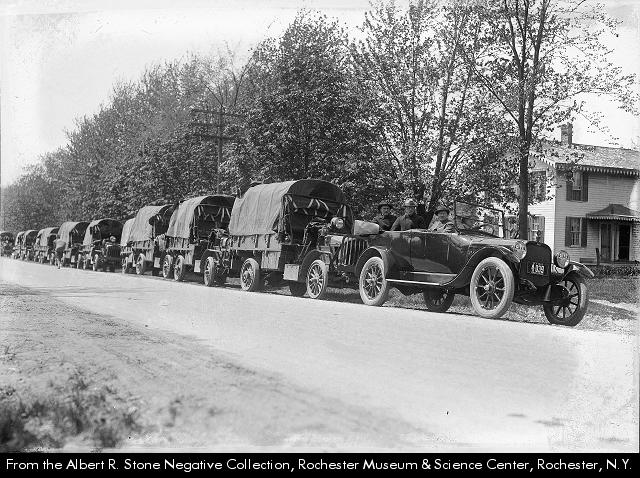
1918 Caravan of red cross supplies

A caravan of red cross trucks delivery food and supplies to ill families

In Rochester, there were 3,333 cases and the death rate was almost double from a year before. There were eight more deaths including individuals who lived on Rugby, Epworth, and Jefferson.

Because Rochester saloons were closed, people were running to the saloons in the surrounding towns and villages where those establishments were still open.

More nurses were needed, so the Red Cross was now looking for men to help out.  IT was found that when nurses went to visit the sick that the nurses or others “find whole families prostrated with nothing in the house to eat. In other cases the only persons in the family who can cook are ill and others have to make out as well as they can.” As such an emergency food corps was formed yesterday noon to cook foods and make broths to deliver to these families.  Families, except those in extreme poverty, were expected to pay a reasonable price for this food.

© words by Dan DeMarle 4/28/2020

October 16th, 1918 Rochester and the Influenza pandemic

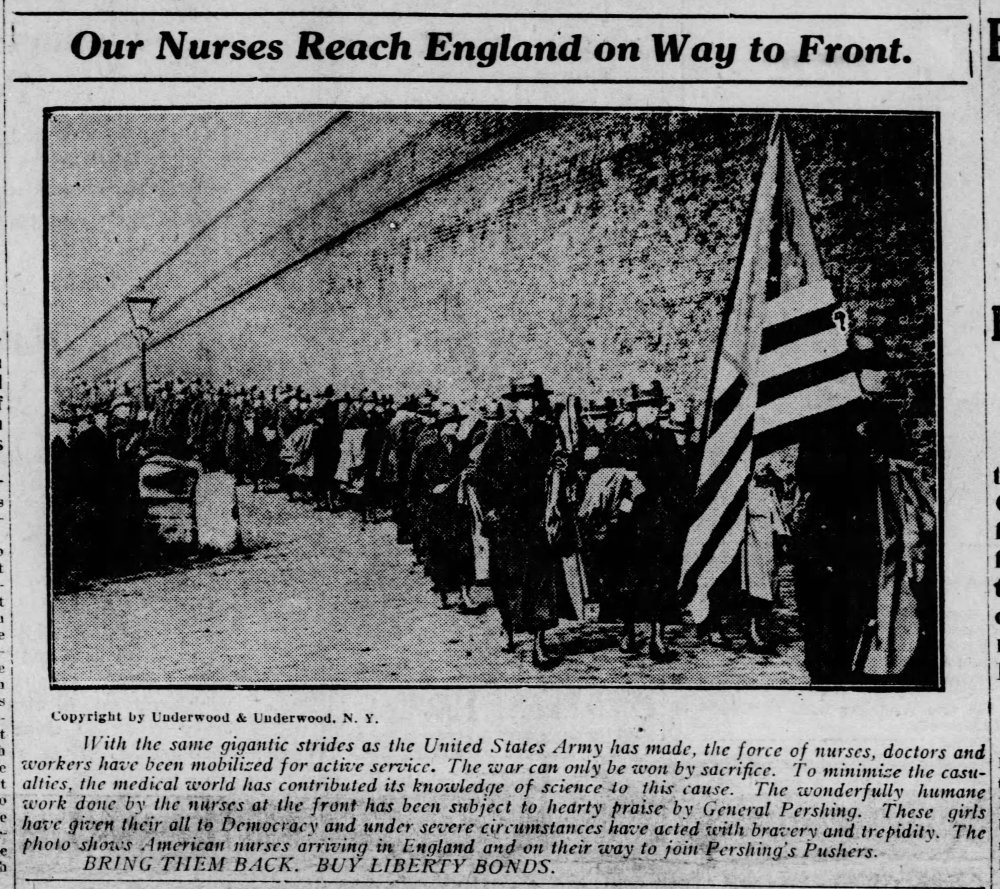
The War continued abroad and across the country, the influenza pandemic was now in every State. While most movies portray young men serving, there were also many, many women who served.

1918-10-16 Nurses reach England Democrat_and_Chronicle_Wed__Oct_16__1918_More than 1,476 U.S. Navy nurses (American military nurses were all women then) served in military hospitals stateside and overseas. Over 400 U.S. military nurses died in service, almost all from the Spanish flu epidemic which swept through crowded military camps, hospitals, and ports of embarkation.[3][4]

The first American women enlisted into the regular armed forces were 13,000 women admitted into active duty in the U.S. Navy. They served stateside in jobs and received the same benefits and responsibilities as men, including identical pay (US$28.75 per month), and were treated as veterans after the war.

In Rochester, there were 442 new cases, making a total of 2,684 cases. That, however, was only with one-half of City physicians providing the data. There were 21 deaths the day before.

1918-10-16 Epidemic in all States Democrat_and_Chronicle_Wed__Oct_16__1918_

© words by Daniel DeMarle 4/28/2020

October 15th, 1918 Rochester and the Influenza pandemic

President Wilson turned down the peace request from Germany.   4,217 new cases were reported in NY.  Deaths totaled 222-235 in 24 hours, this was compared to 168 the day before. Policemen in NY were ordered to wear gauze masks (that their wives were to make) while sleeping in the barracks.

The federal government was mobilizing for a national campaign against the pandemic.

Rochester was hit by fake news that almost caused a riot. This occurred when a fake newspaper was printed and distributed as a way to increase the sale of Liberty Loans.  It did not go over well.

In Rochester the sale of any liquor, wine, beer, ale, mineral water, or soft drinks to be drunk on the premises as a way to stop the selling of drinks with meals.

Students in the Training Corps at the University of Rochester were now quarantined.

The number of cases in Rochester was 2,242.  There were 12 more deaths the day before.

Directions were given for the care of the sick, on how to make masques, and how to wash your hands.

With Schools in Rochester closed, the Superintendent and Principals went “back to the farm” where they picked apples on an apple farm.

Teachers pick apples

Image A group of school principals help with apple picking while school is closed because of the influenza epidemic. Click here for link.

© words by Dan DeMarle 4/16/2020


October 14th, 1918 Rochester and the Influenza pandemic

The World War continued. After declining for three days the mortality advanced in Rochester with nine more deaths making a total of 31 to date in October.  Influenza cases were not expected to let up for two to three weeks.  Seven Coast Guard service members from the Rochester Coast Guard Station were ill.

Not only was America fighting a war, and a pandemic, but it was also flu season.  Across the nation, there were 168 deaths for influenza, but there were also 216 deaths from the flu.  This is why there is a concern that if COVID-19 comes back or is still here in the fall that we will have both illnesses going on at once.

© words by Dan DeMarle 4/25/2020

Dora Sigerson 8/16/1866 – 1/6/1918

Dora Sigerson

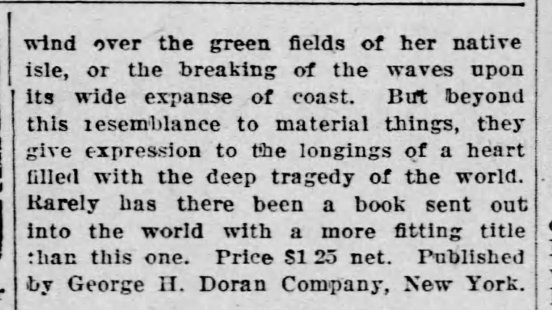
Reading about the 1918 Flu Pandemic in Rochester in the paper on 10/13/1918, I come across a book review for the work of Dara Sigerson who was described as one the real poets of Ireland.  She had died in 1/1918 in Ireland. Before her death, she had gathered some of her poetry together for publication.  The poems of the book covered the time around the Great War (World War I).  Then I found myself finding the book in Google Books, and then wandering Ireland during the Great War.

A selection from “The Road of the Refugees”

“..Hear the lost feet straying, from the roadway slipping.     They will walk no longer in this march appalling
Hear the sound of rain dripping, dripping, dripping,
Is it rain or tears? What, O God, is falling?”
For more information about her life click here.

1918-10-13 Dars Sigerson Democrat_and_Chronicle_Sun__Oct_13__1918_a1918-10-13 Dars Sigerson Democrat_and_Chronicle_Sun__Oct_13__1918_b

October 13th, 1918 Rochester and the Influenza pandemic

The big news was that Germany agreed to the US peace proposal.  Coverage of the pandemic moved to the front page of the paper.  It was now recommended that everyone was to wear a mask to prevent the spread of the epidemic. This was in part because of an acute shortage of doctors and nurses. So the call was to not overwhelm the health system.

In Rochester, there were 471 news cases with a total of 1,119 cases, which was thought to the about one-third of the true cases.  There were 5 more deaths bringing the total to 22 in October.

All churches, saloons, hotel bars, club rooms, soda fountains, and ice cream parlors were now ordered closed as of midnight on 10/12/1918.

Considerable interest was expressed in Rochester over the “cure” offered from Dr. Roby in Pittsburgh.  Camphor was in high demand as there was a belief that strong odor could ward off the disease.

Bishop Thomas F. Hickey endorsed the closing of the churches and encouraged social distancing.


© words by Dan DeMarle 4/24/2020


October 12th, 1918 the Influenza pandemic and Rochester, NY

On page 1 of the paper is a Pittsburgher claiming to have found a cure for the Influenza.  Dr. Herman Biggs, State Commissioner of Health was given charge of the epidemic which was noted to be worse upstate than in NY City.  It was now a crime to cough or sneeze in a public place anywhere in the State without covering the mouth or nose and punishment will be $500 or one year in prison or both.  The paper reports three hundred new cases and six more deaths bringing the total for the month to 17 deaths.


© words by Dan DeMarle 4/22/2020

October 11th, 1918 the Influenza pandemic and Rochester, NY

The ongoing World War I takes up much of the paper with information on the influenza epidemic in the back pages of the paper. The Surgeon General recommends what we now refer to as social distancing from the ill to the extent possible in overcrowded houses and recommends lots of fresh air. Nurses and patients are recommended to wear gauze masks. Women in Rochester are asked to sign up to help treat the ill. In the courts, one member of a jury became sick during jury deliberations and went home after leaving their vote for the judge. In another case, it was noted that “The rest of the case will be tried at some future date because the plaintiff as well as the members of her family are in the hospital suffering with pneumonia.” For the first time the “disease yesterday was classed as reportable and it became possible for the first time to obtain a fairly accurate idea of the number of cases in the city.” About 2,500 people in Rochester were ill. There were 25 deaths since the start of the month. Doctors were not shocked as there were normally 40 or more deaths for pneumonia in a month. Nonproven remedies were offered. Deaths from the War and from the pandemic were both reported in the paper.

© by Daniel DeMarle 4/22/2020

October 9th, 1918 the Influenza pandemic and Rochester, NY

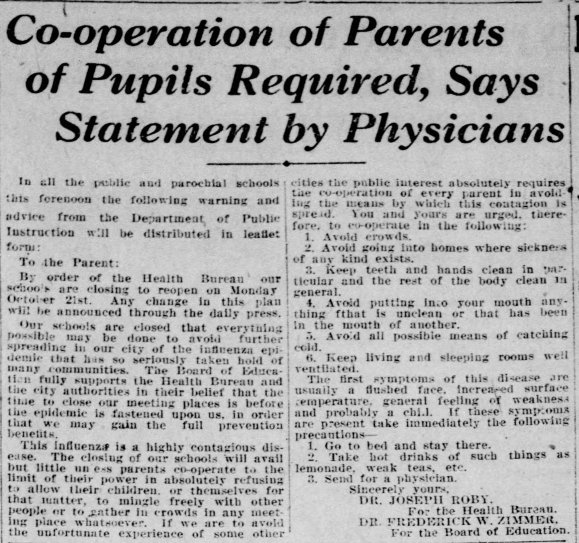
On 10/9/1918 the Common Council gave Commissioner of Safety power to fix working hours in Factories and Stores, that crowding in Trolley Cars, and Streets may be prevented They then ordered all public, parochial and private schools closed until May 21st. There were an estimated more than a thousand cases in the City. Six individuals including 4 that day had already died including one physician. There were now special wards for influenza patients at General Hospital and they were now full. Nineteen nurses were ill.

1918-10-9 Flu schools closed Democrat_and_Chronicle_Wed__Oct_9__1918_

© words by Dan DeMarle 10/9/1918